

TMVW
Comfort and energy efficiency were at the forefront of the design. As a first for Belgium, concrete core activation with Slimline concrete elements was chosen. This is a lighter, space-saving floor structure that still retains the benefits of concrete core activation. The structural aspect of the construction was fulfilled by C-metal.
(< 800 tons of steel)
Project properties
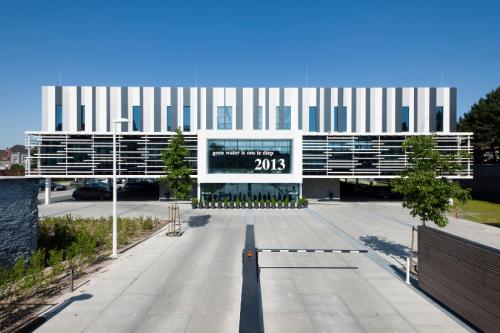
The new building is located near the existing TMVW office on the Stropkaai in Ghent, and opens onto Stropstraat behind it. The technical and logistics services were grouped at the back, along the river, while the reception and administration areas were housed in the new building, which is accessible via a separate entrance on Stropstraat.

About Slimline
This system is based on 8cm concrete precast slabs (note: with embedded activation tubes), which are attached to 70cm steel I-beams (i.e. steel IPE 600 beams, 60cm high). The beams are then suspended between the girders to form a ceiling structure. Dovetailed metal sheets are placed on top, to which underfloor heating pipes are attached. The upper surface is completed with poured mortar.
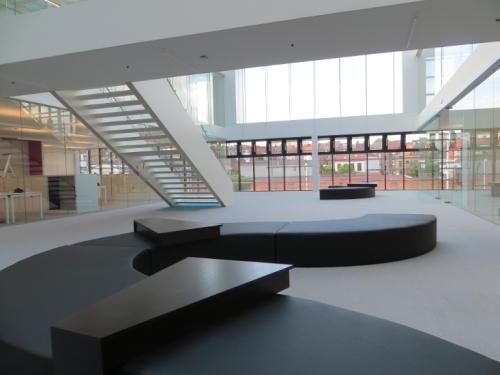
A major advantage of this approach is that one has a hollow floor. As such, all the technical features can ben put in the space between the beams: air ducts, pipes, cabling, sprinklers and so on. False ceilings, raised floors, or shafts can all be omitted. Each floor thus gains a lot of space. For example, the building at TMVW is 120 cm lower than if it had been built on a conventional principle. Furthermore, one gains some flexibility in operation. Because there is less concrete mass, control is faster than with a heavy system. With a response time of two hours, it is flexible enough to provide the manager with a degree of control, although of course it responds more slowly than high-temperature heating.
Finally, it is possible to work with precast components, unlike a conventional concrete core activation that requires everything to be done on site: applying the reinforcement, attaching the pipes, pouring and curing the concrete, etc. This offers greater control over production and the on-site assembly can be smoother.